
Where does Transport for West Midlands spend its money? (2026/27)
1. Who we are and what we do
We are Transport for West Midlands (TfWM), part of the West Midlands Combined Authority (WMCA). We strive for a vibrant region fuelled by transport choices that are not just inclusive and fair, but appealing. We're here to offer options that people want to use, all while positively shaping our community, improving the local environment, and boosting the health and happiness of our residents.
Our purpose is to ensure there are journeys for everyone so as a combined authority, we can create a better connected, more prosperous, fairer, greener and healthier region.
Our team is proud of what we do. It's not just about helping our residents and visitors travel safely, reliably, and affordably – it's about creating journeys that people want to repeat and are accessible to everyone. We’re motivated to not just maintain, but enhance our local surroundings, and champion a transport system that leaves a lasting, sustainable legacy, touching every corner of our community.
As an organisation, we do many things to make our transport system function most effectively for the customer and deliver experiences that they want to repeat. As well as supporting, convening and influencing we:
 |
PlanWe work across the WMCA, with local authorities and their communities to develop and fund strategies and solutions that not only address current needs but pave the way for the future, ensuring that we consistently stay one step ahead. |
 |
BuildFrom metro extensions to priority bus routes to new rail stations to world-class ticketing solutions, we are building a transport network that delivers for the everyday needs of the West Midlands. |
 |
OperateAnd once we build it, we make sure that we continuously improve it to meet the changing demands of the traveling public and ensure their experience lives up to the expectations. |
Through all of this, we empower our team to be collaborative, driven, inclusive and innovative. Working with partners, we combine our expertise and energy, to work in the best interests of the transport user and residents of the West Midlands.
This page outlines to you, where we spend your money. The total budgets (revenue and capital) of West Midlands Combined Authority is shown below:
Capital Programme
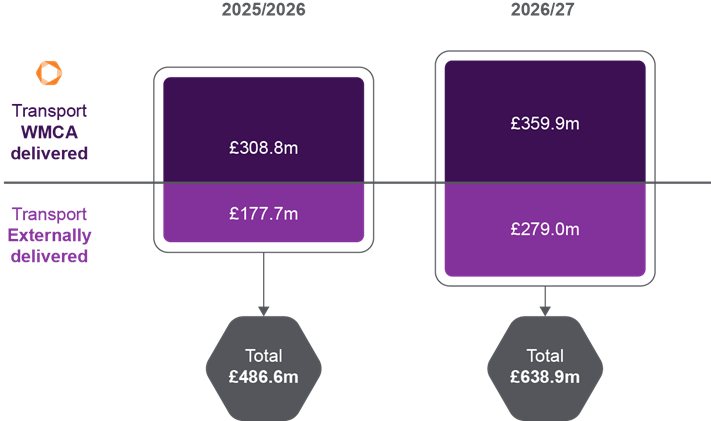
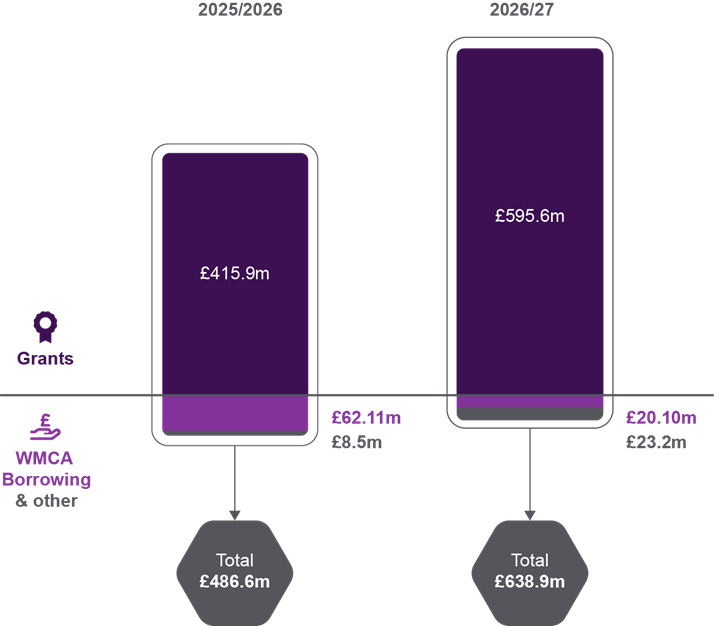
This supports the delivery of the capital programme:
| Funding | 2025/26 £m |
2026/27 £m |
| Grants (£m) | 415.9 | 595.6 |
| Borrowing (£m) | 62.11 | 20.10 |
2. Supporting our Community
Each year all seven of the West Midlands Local Authorities contribute money to the annual transport budget. This is called the Transport Levy. It is used to provide transport services to communities across the region. The contribution from each council is:
| Council | Population | Levy £m | % |
| Birmingham | 1,183,618 | 49.4 | 39.0% |
| Coventry | 369,026 | 15.4 | 12.2% |
| Dudley | 331,930 | 13.8 | 10.9% |
| Sandwell | 353,860 | 14.8 | 11.7% |
| Solihull | 221,242 | 9.2 | 7.3% |
| Walsall | 295,678 | 12.3 | 9.7% |
| Wolverhampton | 281,251 | 11.7 | 9.3% |
| Total | 3,036,605 | 126.6 | 100.0% |
This is equal to gross levy (before tax) of £41.70 for each resident. Individual councils receive central government funding towards these costs.
This funding covers the delivery of the following transport services and functions:
TfWM Budget Spending |
2025/26(£m) |
2026/27(£m) |
| Concessions for elderly and disabled people | 49.7 | 52.9 |
| Child Concessions | 6.8 | 9.0 |
| Rail and Metro Concessions | 4.6 | 4.7 |
| Accessible Transport | 6.9 | 7.0 |
| Subsidised Bus Services | 85.6 | 86.9 |
| Bus Services and Infrastructure | 23.8 | 8.5 |
| Bus Franchising | 0.0 | 15.4 |
| Integration (inc Safety & Security and Passenger Information) | 18.3 | 18.6 |
| Rail & Metro Services | 19.7 | 21.1 |
| Network Resilience | 2.8 | 4.2 |
| Strategic Development & Transport Democratic Services | 18.5 | 24.4 |
| Business Support Costs | 6.2 | 9.2 |
| Financing Costs | 14.4 | 10.5 |
| Efficiency Target | -0.6 | 0.0 |
| Total Expenditure | 256.7 | 272.4 |
| Revenue Grants | 133.7 | 92.9 |
| Use of Reserves/Income | 0.0 | 19.4 |
| Funded by District Levy | 122.9 | 126.6 |
| Remaining Funded Gap* | 0.0 | 33.4 |
| *the gap will be funded by corporate income |
Funding public transport in the region helps resident access jobs, education, healthcare services like GPs and leisure activities. However, TfWM also provides various support measures for young people, the elderly and those out of work through our Supported Travel Policies. Our range of services includes offering travel tickets, managing bus stops and stations, ensuring the safety and security of travellers through the Safer Travel Partnership, and staffing these services.
The English National Concessionary Travel Scheme
More than half the levy funds the English National Concessionary Travel Scheme (ENCTS) to provide older and disabled people (who qualify) for free bus travel.
This scheme is improved with further local funding to cover train and tram travel for those who qualify.
Tendered Bus Network
We also subsidise our bus network, providing contracted services which are not commercially viable for our operators to run but considered socially necessary.
These contracted services have continued to come under pressure from inflationary factors including high fuel and labour costs and slow recovery, the Government has provided further grant funding which has allowed the WMCA to support the commercial network locally.
Approximately £170m of funding has been provided to the Authority to invest in the wider network from 2020 to 2025. This funding has also supported the introduction of simpler fares following the increase of the national £2 fare cap which took place in December 2024. When combined, these measures have helped maintain our bus network.
Safer Travel Partnership
TfWM has a vital role to play in maintaining a safe and secure transport network. We are a part of the Safer Travel partnership which works with British Transport Police and West Midlands Police to keep the travelling public safe.
We have a dedicated team of Police Officers and twelve Transport Safety Officers who patrol the bus, train and tram network.
Supported Travel Policies
Through the Supported Travel Policies, funded through the levy, TfWM has provided additional support beyond that of the national statutory minimum. This support includes:
 |
Child concessionsThis includes bus and tram only. Impact in 2025:
|
 |
Rail and Metro concessionsImpact in 2025:
|
 |
Accessible transportThis includes Ring and Ride and West Midlands on Demand services. Impact in 2025:
|
 |
Tendered bus networkThis covers routes, or section of routes, that require subsidy because they are not commercially viable. Impact in 2025:
|
 |
Night time support'Night time support' refers to the ENCTS post 11.00pm add-on. Impact in 2025:
|
In addition to the core supported travel policies, additional funding has been sourced for TfWM to provide:
|
|
Bike schemes Access to bikes through subsidies to people on low incomes |
 |
WorkWise Scheme Continue to deliver free travel, for up to 3 months for those newly securing work opportunities |
 |
Refugee Travel Support Scheme Inform relevant organisations of NXs refugee offer of support, for free travel for 12 weeks |
|
|
Bus Service Improvement Plan’s Passenger Incentives Scheme Providing free or discounted bus tickets to encourage people to use alternative modes of transport to the car, with a particular emphasis on targeting groups for whom affordability is a barrier to travel |

3. Growing the Transport Network
The West Midlands has an extensive and ever-growing transport network. TfWM is continuing to invest in and support that growth. In 2024/2025, the following journeys have been undertaken:
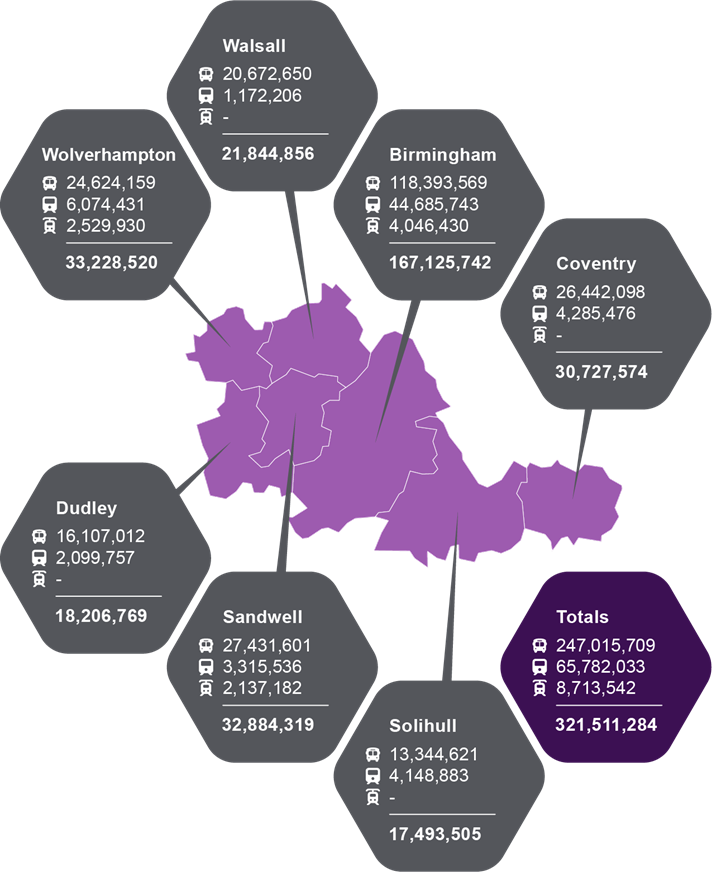
Annualised patronage has increased across all public transport modes with a continuing return to pre-Covid patronage levels. Bus recovery is one of the main challenges that operators have faced in providing a commercially sustainable network.
The Passenger Incentive Programme (PIP, funded by the Bus Service Improvement Plan) is incentivising modal shifts via organisational partnerships whilst also supporting groups and individuals that will benefit most from travel support, with over 11.2 million individual bus journeys made since it's inception.
Workwise
The workwise programme provides up to 12 weeks free and discounted travel for eligible newly employed people. The scheme encourages use of sustainable travel options to get to work and helps bridge the financial transition between starting work and the persons’ first pay days.
| April 2024 to March 2025 | Number of travel tickets issued through Workwise |
| Total | 1,474 |
| Birmingham | 735 |
| Coventry | 155 |
| Dudley | 74 |
| Sandwell | 193 |
| Solihull | 70 |
| Walsall | 95 |
| Wolverhampton | 107 |
| People commuting into WMCA area | 45 |
Investing in the transport network
The network itself is continuing to grow, TfWM receives extra funding to support and grow the transport network. There are a number of funding agreements from central government that are spent in the region.
Across the different transport modes, the following investments are being made:
Bus and Sprint Bus
In 2025/26, the City Region Sustain Transport Settlement (CRSTS) funding pot of £1.05bn, was awarded from 2022 to 2027. This has facilitated the delivery of schemes such as Dudley Bus Station, which is linked to the wider interchange and metro line, Sprint bus routes on the A45 in Solihull and Birmingham and we are also developing the Cross-city bus route improvement programme, which will provide more reliable journeys
Rail
There are five new railway stations in development, three in Birmingham at Moseley, Kings Heath and Pineapple Road, plus two in the Black Country at Willenhall and Darlaston. All are scheduled to open in early 2026. These schemes have been made possible thanks to CRSTS funding as well as the WMCA’s Investment Fund.
Metro and Very Light Rail
In 2025/26 the combined funding will continue to support key project delivery. Thanks to some flagship regional projects, the West Midlands will move to a genuine Metro network serving new communities and connecting the region to new destinations in the Black Country and Birmingham
Services are planned to start on the first phase of the Wednesbury to Brierley Hill Extension in the Black Country, and delivery of Phase two to Merry Hill will continue. Work also continues on the second phase of the Birmingham Eastside Extension in Birmingham City Centre, linking the Metro network with the proposed HS2 Station at Curzon Street, and paving the way for future extensions to the proposed Sports Quarter and beyond. In addition to this, we will also continue to ensure that the region benefits from a safe and reliable Metro service by undertaking maintenance and renewals across our network.
Meanwhile, the work of transport innovation continues to move at pace. The region is at the heart of trialling Very Light Rail research in Coventry, which is testing a new kind of vehicle and track that could bring down the costs of developing a transport network.
Transport Infrastructure
TfWM are responsible for over 11,500 stops and shelters, 65 park and ride sites and 12 bus stations. These vital customer facilities are operated and maintained to ensure they are clean, safe and available for all to allow accessibility to the region’s transport network.
Highways
The roads of the region are vital. The CRSTS funds ongoing highway maintenance work in 2025/26 across Solihull, Coventry, Dudley, Sandwell, Walsall and Wolverhampton.
Electrifying the network
TfWM recognises the need to move to cleaner fuels in use in the transport network as part of a wider air quality strategy, this is because road transport in the West Midlands is the direct source of 82% of Nitrogen Dioxide emissions and 19% of fine particles (PM 2.5) emissions, the UK’s two main air pollutants. 413 zero-emission buses now operate within the West Midlands, secured through over £60m of public sector funding as well as co-investment from National Express and Stagecoach. In 2026, TfWM will deliver the Coventry’s Electric, the UK’s first all-electric bus town or city. Through this and further funding through ZEBRA grants the total zero-emission fleet in the West Midlands will grow to 517 buses - over 25% of the network.
In addition to the public transport network, TfWM is supporting private and fleet vehicles through the development and delivery of public infrastructure for Zero Emission Vehicles, with £40 million secured from Government funding to enable our communities and business to transition away from combustion engines for cars and vans.
Active Travel and micro-mobility
Ensuring the West Midlands is a prosperous and happy society is linked to levels of active travel. It benefits people's health, their state of mind and generates environmental and economic benefits. TfWM will work with Local Authorities and Active Travel England to spend £21,182,890 in 2025/26 on Active Travel measure supporting people to walk and cycle more often in a safe and secure environment